


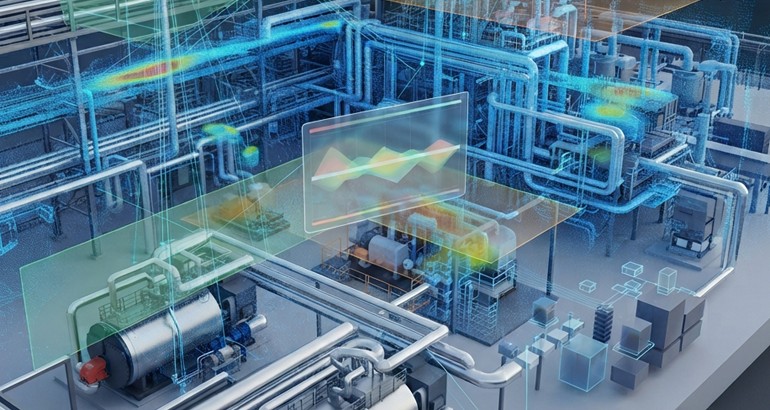
While 3D laser scanning technologies can capture billions of data points when digitizing large-scale industrial facilities, the true determinant of project success lies in structuring the measurement workflow around specific engineering requirements. Ölçek Mühendislik manages laser scanning operations not merely as data acquisition, but as an end-to-end engineering discipline.
Modern 3D laser scanning technologies enable the precise documentation of complex, large-scale industrial facilities through high-density point cloud data. However, capturing billions of points or utilizing state-of-the-art hardware alone does not guarantee a reliable, engineering-ready deliverable.
In complex industrial environments—where dense piping networks, steel structures, critical equipment, and restricted-access zones intersect—the data acquisition strategy must be meticulously planned before field operations begin. Without an engineering-led approach, massive datasets often fail to meet the accuracy and usability standards required for downstream design, retrofit, and asset management workflows.
Five Core Pillars of a Successful Laser Scanning Workflow
To ensure that 3D laser scanning outputs integrate seamlessly into engineering processes, field and office operations must be governed by five fundamental principles:
- Strategic Scan Planning: Defining scan positions, lines of sight, and data coverage prior to mobilization based on specific project and engineering requirements.
- Measurement Control Network: Registering and aligning datasets captured from multiple scan stations into a unified, verifiable coordinate system.
- Data Integrity Verification: Systematically evaluating blind spots, scan overlap zones, and potential data gaps caused by dense facility geometry to ensure complete spatial coverage.
- Accuracy and Tolerance Control: Validating measurement uncertainties and registration accuracy against strict project tolerance specifications.
- Structured Data Management: Filtering, classifying, and structuring massive point cloud datasets so they are optimized and ready for subsequent CAD, BIM, and digital twin workflows.
From Technological Capacity to Engineering Expertise
At Ölçek Mühendislik, 3D laser scanning is approached not simply as a digital recording of physical assets, but as an integrated workflow requiring rigorous engineering discipline—from initial survey planning to final data validation. Generating high-density data is a capability of modern hardware; transforming that raw data into a reliable, consistent, and actionable foundation for engineering decisions requires true domain expertise.